
Why I started Sell Right.
The reps who sell properly lose to the ones who push. I do not think that is a fact of the profession, and this is the short version of why.
Your sales team should not need you to hit targets. The Sales Health Audit is a free 1-on-1 with Ryan, Singapore-based and working with founder-led sales teams across Asia, scored live across Purpose, Belief, and Method while you watch.
Free, 30 minutes, and no proposal at the end of it unless you ask for one.
It is scored live, on a shared screen, while you watch. Not a form you fill in, and not a PDF that arrives by email afterwards. Ryan works through the questions with you and you can push back on any answer as it goes in, so nothing gets scored behind your back.
You describe your sales setup. We tell you which of the 3 obstacles you are actually dealing with, and whether what we have fixes it. If it does not, we will say so on the call, and you will still leave with the report.
No generic frameworks, and no sales pitch. It is 30 minutes spent on your floor, your numbers, and what is actually holding the month together.
You leave with
A Sales Health Score out of 100, built from 3 separately weighted areas.
You keep the report either way. There is no deck, and no follow-up emails afterwards.
From the outside, the business looks established. You have leads, customers, and a sales team. But if revenue still depends on you stepping into calls, coaching every rep, and your best 2–3 closers carrying the month, the problem is not headcount. It is the absence of a repeatable sales system.
Tick what is true on your floor this quarter
0 of 9 Tick the ones you recognise.
Book My Sales Health AuditAlmost every founder or manager at this stage has already run the same 3 plays.
Every one of those is a people fix or a tool fix, and none of them installs a method that outlives the person who taught it. Which is why the improvement lasts exactly as long as your attention does.
Systems that produce self-sufficient sales reps who consistently and predictably hit targets after we leave. So results do not depend on you micromanaging, or on your best 2–3 reps carrying the team.
This is not a sales course. It is a sales operating system that trains forward after we leave.
3 areas, weighted, because they do not carry equal load. Most founders can name the area they think is weakest. It is often not the one the score finds.
20%
Whether your reps know why they sell, and why this company deserves to be sold for. Thin here and nothing above it holds under pressure.
30%
Whether a rep believes they can sell, and whether that survives a hard month. This is where quiet reps quietly write themselves off.
50%
What actually happens in front of a buyer. Half the score sits here, because this is where the deal is won or lost, and it is the area founders see least of.
The score sits on a 4-band scale
Founders rarely describe the goal as a sales system. They describe it like this.
30 minutes, in 3 parts. You do most of the talking in the first 10.
Minutes 0–10
Headcount, ramp time, what share of last quarter came from your top 2 reps, where deals stall, and what you have already tried. I ask, you talk. Nothing to prepare.
Minutes 10–20
Purpose, Belief, and Method are scored separately on the shared screen. You see each answer go in and you can argue with any of them before it counts.
Minutes 20–30
Which of the 3 obstacles is costing you the most, and roughly what that is per quarter, worked out from your figures rather than an industry benchmark.
What it is not. You will not sit through a demo or a deck, and I will not spend the 30 minutes talking at you. If your real gap is lead generation rather than selling, or a system will not fix what you are describing, I will say so and end the call early.

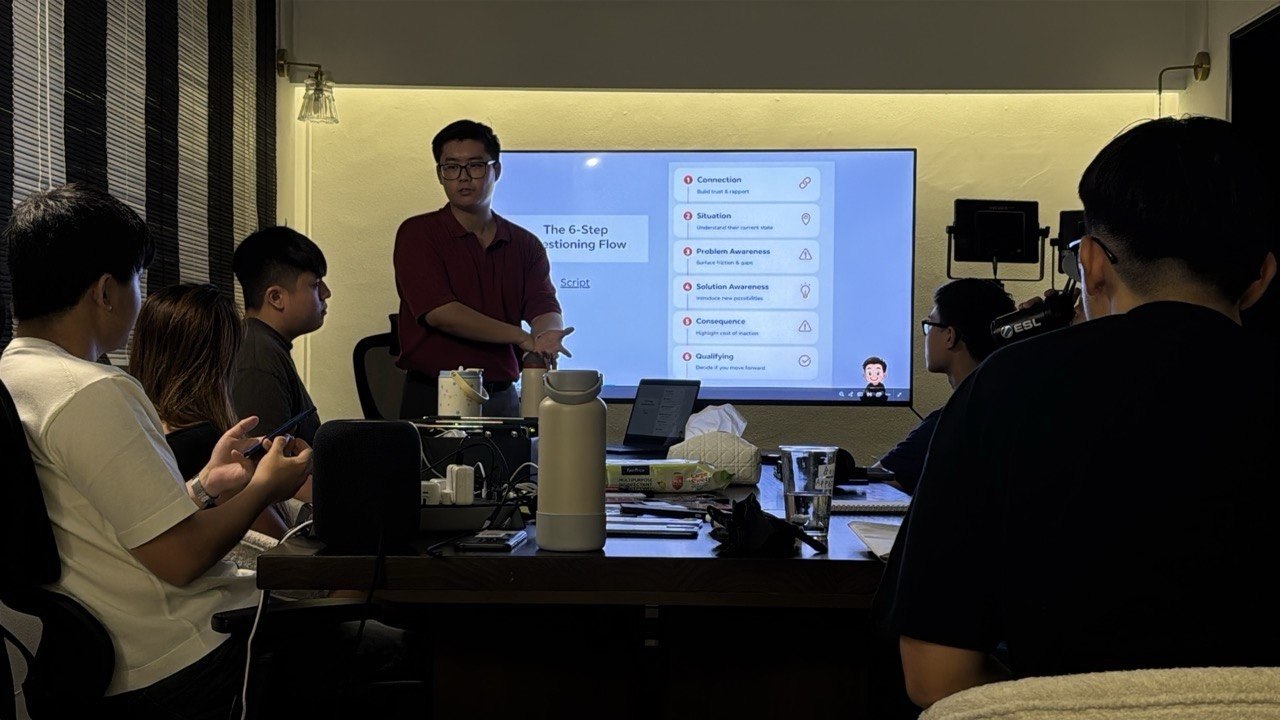
Ryan started selling at 17, through his first business in vending machines. Across 11 years since then he has sold B2B and B2C across several industries, run his own sales floors, and coached 119 founders, managers and reps through the same plateau your team is sitting on.
He is not a natural closer, and he is not an extrovert. He built a system that repeatedly works, through trial and error, after years of watching pushier reps outperform people who sold properly. That is a training failure, not a fact of the profession, and closing that gap is the whole reason Sell Right exists.
Selling isn't a personality trait. It's a trained skill, and we make sure it's trained right.
Both are the client's revenue, not Ryan's. He coached the floor, the company owned the result.
The reps who sell properly lose to the ones who push. I do not think that is a fact of the profession, and this is the short version of why.
Different products, different buyers, different personalities. What these people have in common is the thing they were taught to run, which is the whole argument for a system over a personality.
Saying who this is not for saves us both 30 minutes. If you are on the right-hand list, I would rather you knew now than found out on the call.
It is a real diagnostic, and you leave with the scored report whether or not anything follows. What I will not do is pretend there is no commercial interest: if the diagnosis points at work we can do, I will say so at the end and you can ask for a proposal or not. There is no deck, and I will not chase you with emails afterwards.
Engagements run 6 months and are priced as a monthly retainer. I will give you the number on the call once I know the size of your floor, because a 6-rep team and a 20-rep team are not the same job. The audit itself costs nothing and does not commit you to hearing the price.
That is usually a symptom of the thing being diagnosed. If your calendar cannot absorb 30 minutes, it is worth asking how much of it is currently spent on calls your reps should be handling. Book the earliest slot that is genuinely free, even if it is 3 weeks out.
Neither do we. Generic training is a syllabus delivered to a room. This is a system installed on a floor, using your deals, your objections, and your reps. If we ran the same 6 months at another company the artefacts at the end would look different, because they are built out of your calls.
The product knowledge is different. The diagnosis is not. Every complex sale has a buyer with a problem they have not fully priced, and a rep tempted to pitch before understanding it. Your reps supply the industry, we supply the method, and we learn your industry on your floor in the first 2 weeks.
They do, and that is the exposure. Right now their method lives in their heads, which means you cannot hire against it, coach against it, or replace it. Part of this work is extracting what your top 2 or 3 already do and making it teachable to the other 15.
Most training is an event with no owner afterwards. That is why the handover is a phase rather than a promise. Your manager runs the coaching system in front of us before we leave, on real reps, with us watching. If they cannot run it, we are not finished.
That is the correct thing to worry about, and it is the specific claim being made here. The promise is that targets still get hit after we leave. It is falsifiable on purpose. Staying on past the 6 months is available, but needing it is not the plan.
Pick a time that suits you. You will get a calendar invite with a video link, and one reminder. Nothing to prepare, and no forms to fill in beforehand.
30 minutes gets you the score before the month does, which of the 3 obstacles is costing you the most, and roughly what that is per quarter. If a system will not fix it, we will tell you on the call.
At no cost, and you will not be added to a mailing list.